WELCOME!

This blog shares my stamp collections and highlights individual items which I feel might be of interest to others.

While my focus is on the stamps of the Philippines, you will find classic stamps, aviation covers, postal history, and many others included.

I hope you enjoy my blog, and please visit often!

Dedicated to Almira and our children, Jimmy, Ana, Lance, and Isabella.

Thursday, April 22, 2010

USA - ESSAY 70-E3a, 24-CENTS, BROWN DIE ESSAY, SCHERNIKOW REPRINT, 1903


USA, ESSAY 70-E3a
(SCHERNIKOW REPRINT, 1903)
24-CENTS, BROWN DIE ESSAY PULLED ON PROOF PAPER AND DIE SUNK ON CARD. 
THIS DESIGN WAS TAKEN FROM THE 24-CENTS 1860 ISSUE (SCOTT #37), WITH SPACES CREATED FOR NUMERALS, BUT BEFORE NUMERALS WERE ADDED.

In the early 1900s, the archives of the Philadelphia Bank Note Company were sold in a bankruptcy sale.   Among the items sold were the duplicate dies of the 1851-1860 issues, which the Philadelphia Bank Note Company inherited from Toppan, Carpenter and Company.  The Philadelphia Bank Note Company modified these dies by adding numerals to all the values, except the 10-cent and 30-cent denominations.  The modified dies were submitted as essays with their proposal for the 1861 contract.

The buyer of the dies was Ernest Schernikow, an officer of the Hamilton Bank Note Company. In 1903 they made reprints from the dies in as many as fifteen colors. It is believed that this was done to help recoup the $10,000.00 Schernikow paid for the effects of the Philadelphia Bank Note Company.

Wednesday, April 21, 2010

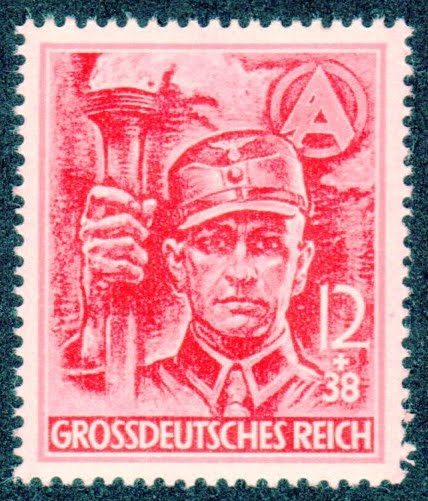
GERMANY - THE LAST STAMPS ISSUED BY THE THIRD REICH, 20 APRIL 1945


GERMANY, THIRD REICH
SCOTT B292-B293
ISSUED 20 APRIL 1945
IN BERLIN, GERMANY

It has been 65 years since Hitler's Third Reich issued its last postage stamps, before it was finally crushed under the overwhelming weight of Soviet and Allied forces.  These stamps were issued on April 20, 1945; the Soviets launched their final thrust into Berlin the following day.  Germany would finally surrender unconditionally on May 7, 1945.

In "Philately of the Third Reich", author Alf Harper wrote that these two stamps were actually issued as part of a never to be completed set of five stamps honoring various Nazi party formations.  These stamps honored the SA and SS (an earlier released stamp honored the Volksturm, or People's Army; the last two unissued stamps were for the NSKK and NSFK).

Wednesday, April 14, 2010

USA - A FEW OF MY FAVORITE REVENUE STAMPS - PRIVATE DIE PROPRIETARY STAMPS

April 15 is the annual deadline for American's to file their income tax forms with the Internal Revenue Service.  For many procrastinators, tomorrow will be a very stressfull day indeed! 

Luckily, I finished and submitted my tax forms electronically to the IRS last week, so all I have to do now is wait for my Tax Refund.  Thank you to my lovely wife for keeping the pressure on me to "GIT 'ER DONE!"

In honor of April 15, I thought it most appropriate to post my favorite revenue stamps from my collection.  And among US Revenue stamps, some of the most beautiful and whimsical were the Private Die Proprietary stamps.

These revenue stamps were issued to help alleviate the extraordinary financial demands of the American Civil War (1861-1865) on the US Federal Treasury.  The Revenue Act of 1862 required revenue stamps to be affixed to boxes or packages of matches, proprietary medicines, perfumes, playing cards, and even documents.  

Private Die Proprietary stamps came about when manufacturers were permitted, at their expense, to have dies engraved and plates made for their exclusive use.   Many were willing to do this because of the obvious advertising value.  These stamps were in use between 1862 to 1883. 

(Click on the stamps to enlarge them.)

PRIVATE DIE PERFUMERY STAMP
SCOTT RT4, "CORNING & TAPPAN" FOR PERFUME

PRIVATE DIE MEDICINE STAMP
SCOTT RS64 "CHARLES N. CRITTENTON" FOR PIKE'S TOOTHACHE DROPS AND GLENN'S SULPHUR SOAP

PRIVATE DIE MEDICINE STAMP
SCOTT RS65 "OLIVER CROOK & CO." FOR DR. CROOK'S WINE OF TAR

PRIVATE DIE MEDICINE STAMP
SCOTT RS187 "NEW YORK PHARMACAL ASSOCIATION" FOR LACTOPEPTINE

PRIVATE DIE MEDICINE STAMP
SCOTT RS249 "S.R. VAN DUZER" FOR HAIR RESTORER

There were many other attractive designs.  If you would like to see more, just let me know.

Happy Tax Day!

SPANISH PHILIPPINES - SCOTT #192 (1 MILESIMA) WITH U.S. MILITARY POSTAL STATION CDS, ILOILO

SPANISH PHILIPPINES - SCOTT #192 (1 MILESIMA)
WITH U.S. MILITARY POSTAL STATION CDS
"MIL. STA. No. 3, PHILIPPINE ISLS., ILOILO, REGISTERED."

Sometimes very common stamps can provide us with very scarce postmarks.  Here is a fine example of a portion of a U.S. Military Postal Station No. 3, Iloilo, Registry Postmark on a Spanish Philippines 1-milesima stamp (Scott #192) during the Philippine American War.  This Registry Postmark was used from June 23, 1899 to February 4, 1901.  Interestingly, this registration cancel is more often found in purple (as illustrated below), than in black.


According to Col. George Goodale's "U.S. Military Postal Stations in the Philippines (1898-1904)" a U.S. expedition was sent from Manila to Iloilo on December 28, 1898, but their landing at Iloilo was postponed until February 11, 1899. After driving out the Philippine "Insurgents", Iloilo was made the headquarters for the Department of the Visayas, U.S. Army, in March 1900.

SPANISH PHILIPPINES - SCOTT #192 (1 MILESIMA)
WITH U.S. MILITARY POSTAL STATION CDS
"...AM, 1899, RECEIVED."

Here is an interesting example of a portion of a U.S. Military Postal Station receiving postmark on a Spanish Philippines 1-milesima stamp (Scott #192) during the Philippine American War.

Based on the relative orientation of the "1899", "RECEIVED", and ... "INE" of PHILIPPINE, I believe this receiving postmark is also from Iloilio (see the example below).  This receiving postmark was used from June 23, 1899 to February 4, 1901.


But why would a U.S. cancel be found on a Spanish Philippine stamp? 

From my recent email correspondence with Don Peterson, a Philippine philatelic expert, he indicated that there were several circumstances that allowed Spanish Philippine stamps (mostly the 1898 issues) to have been cancelled with U.S. military postal station postmarks.

Bags of Un-Delivered Mail:  As U.S. forces took over the Spanish post offices, invariably there were bags of un-delivered Spanish mail present. This was certainly true at the Manila PO, where U.S. records show such bags present. Postmaster Vaille's first priority was U.S. mail. However, using Spanish clerks, he eventually got the Spanish mail cancelled, and arranged with the Spanish Governor-General to have Spanish and Filipino carriers deliver the mail to interior locations using the Spanish mail delivery system. This mail was cancelled with U.S. Military Station postmarks. Although some such mail was sent overseas, most overseas mail was eventually terminated by orders of the U.S. military (this latter statement is more complicated, because there were different rules for mail to Spain vs. mail to other foreign countries).

Short-Term Continued Use of Spanish Philippine (1898) Issues at U.S. Occupied P.O.s:  We also know that until U.S. postage stamps arrived at recently occupied towns, many such post offices were allowed to use Spanish Philippine stamps. This is believed to be very short-lived. 

Philatelic Usage: There was also philatelic usage as well, with the low-value Spanish Philippine stamps added as "decoration" onto outbound foreign mail.  An example of this can be seen at http://www.philippinephilatelist.net/Collections/USPI/uspiPH/rates/Postal%20Rates%204.html.

Even with the possibility of philatelic usage, Spanish period 1898 stamps with Mil. Sta. cancels are scarce. I am quite lucky to have found these.

Tuesday, April 13, 2010

PUERTO RICO - 1877 Provisional Revenue on Scott #16, 25-Centimes

PUERTO RICO - 1877 PROVISIONAL REVENUE
ON SCOTT #16 (25-Centimes)

Since it is "Tax Season" in the USA this week, I'll start tonight's posts with a classic provisional revenue from Spanish Puerto Rico.

The 25-centimes value of the 1877 issue is sometimes found with a large "R" overprinted in black, and many have considered that this stood for a registration receipt stamp, or something of that nature.  The Spanish-language GALVEZ catalog lists this stamp, mentioning that the "R" stood for "receipt", but gives no further details.

The answer has been provided by Antonio Fernandez Duro, a high official in the Spanish postal service at this time and a philatelist of note; he authored the "Resena Historico-Descriptiva de los Sellos de Correo de Espana" published in Madrid in 1881. 

When submitting his budget for the year 1877, the Governor-General of Puerto Rico requested that a revenue stamp be provided to collect a new tax on "recibos y cuentas" (receipts and accounts), the value to be 25-centimes.  The new tax was authorized, and pending preparation of the correct revenue stamp, the 25-centimes postage stamp was pressed into use. 

On August 13, 1877, a Royal Decree authorized the overprinting of the 25-centimes value.  These provisionals were in use from September 6, 1877 until January 1, 1878.   On original document they are very difficult to find; as a matter of fact they are not common in any condition.  (From an article by Preston, R.B. "Puerto Rico, The Alfonso XII Issues For Puerto Rico", published in The Stamp Specialist, Volume 20, 1948)

Monday, April 12, 2010

UNITED STATES - UY5 Postal Reply Card, Speedwell Motor Car Company, 1911

UNITED STATES - POSTAL REPLY CARD, UY5
"SPEEDWELL MOTOR CAR COMPANY"
Dayton, OH to Pacific Grove, CA, CDS dated March 18, 1911

Here's an interesting example of an unsevered preprinted Paid Reply Postal Card, Scott UY5, from the Speedwell Motor Car Company in 1911.  I purchased this item many years ago from a small stamp shop in Carmel, California, which is not far from Pacific Grove, the original destination of this postal card.  I have not seen another example of this reply card since then, so it may be quite scarce, especially since the Speedwell Motor Car Company closed only a few years later.

The Speedwell Motor Car Company was an early United States automobile manufacturing company producing "brass-era" automobiles from 1907 to 1914.  The company's factory rented space for the Wright Company from February to November 1910 while the Wright Company built its own factory building in west Dayton.

1911 Speedwell Model F Special

In 1911, Speedwell built a closed two-door, dubbed a sedan, which was the first recorded use of the term. (ref. Wikipedia)

Thursday, April 8, 2010

AMERICAN CIVIL WAR - GENERAL DANIEL ULLMANN, CORPS D'AFRIQUE, PORT HUDSON, LOUISIANA, 1864

AMERICAN CIVIL WAR, 1861-1865
RARE COVER ADDRESSED TO UNION GENERAL DANIEL ULLMANN
CORPS D'AFRIQUE
PORT HUDSON, LOUISIANA
From Provost Marshal's Office, Thirtieth District, New York
With Buffalo, New York CDS, February 15, 1864

This is a rare example of an official business cover addressed to Daniel Ullmann, Commanding General of the Corps D'Afrique, which evolved from five regiments of black troops raised by Ullmann in Louisiana in 1863. These regiments were the first black troops ordered raised by the Union.


Daniel Ullmann was born in Wilmington, Delaware in 1810. A graduate of Yale (1829) and Madison (1861) universities and member of the New York bar, Ullmann ran unsuccessfully for Governor in 1854 on the American or Know-Nothing ticket.

As colonel of the 78th New York Volunteers, he was captured at Cedar Mountain in August of 1862 and sent to Libby prison. He was paroled in October of the same year.

Ullmann met with Lincoln late in 1862, and tried to convince the President to enlist black troops. Initially, Lincoln had misgivings, but called Ullmann back to further discuss the idea.  In January of 1863, Ullmann was promoted to brigadier general and sent to Louisiana under General Banks. As ordered, he raised five regiments of black troops there. The units were later designated as the Corps D'Afrique. 

He commanded a brigade at Port Hudson, then commanded the post at Port Hudson. After a number of reorganizations and redesignations, Ullmann found himself in Morganza, Louisiana, in command of a brigade of black troops. At times, disease was a greater danger to his command than Confederate forces in the area.

The evolution of black units was not without its problems. Ullmann complained that commanders in the field often chose to use black troops as "diggers and drudges", doing work that white troops disliked. Complaints of this sort led to Secretary of War Edwin Stanton acting to equalize fatigue duty between white and black troops. Ullmann also made the point that often the white officers appointed to black units were less than competent.  

Regiments raised by Ullmann to form the Corps D'Afrique were later redesignated as United States Colored Troops, and performed well in the siege of Mobile in the spring of 1865.  On 26 Feb 1865, Ullmann was removed from command and ordered to report to New Orleans. Reports indicate that he had a severe alcohol problem at the time.  On 13 Mar 1865, he was brevetted to major general. He was mustered out on 24 Aug 1865 and made major general in November 1865.

After the war, Ullmann involved himself with literary and scientific studies. In a speech before the Soldier's and Sailor's Union of New York, he advocated equality of education and universal suffrage as tools for the "regeneration of the South".  He died on 20 Sep 1892 in Nyack, New York, and is buried there.

Wednesday, April 7, 2010

SPANISH PHILIPPINES - 10-CUARTOS, FIRST ISSUE of 1854, Pale Rose. Position 7

10-CUARTOS, FIRST ISSUE of 1854
Early Printing, Fine Engraving
(Scott 2a; Edifil 2b) Used. Pale Rose. Position 7
SCARCE!

Monday, April 5, 2010

PHILIPPINES JAPANESE OCCUPATION - Rare Foreign Mail from Bacolod, Negros Occidental, 1944

To: KOBASHI Touzaburo and FUJII Masuai
Oojima, Kurashiki-Shi,
Okayama Prefecture, Japan

From: FUJII Kohei
Kurashiki Industries Negros Farm
No. 62 Luzuriaga Street
Bacolod City
Negros Occidental Province, The Philippines

COTTON DEVELOPMENT DURING THE JAPANESE OCCUPATION
Rare Foreign Mail from Bacolod, Negros Occidental, 1944

This is a rare example of a non-philatelic Japanese Occupation cover displaying the First Class 7-cents letter postal rate for Foreign Mail that became effective May 15, 1944 in the Philippines. It is franked with a single Scott #N4 "Thick Top Bar" type and a pair of Scott #N12. The stamps are tied to the cover with a poor but legible impression of the "BACOLOD OCCIDENTAL NEGROS, P.I." provincial postmark dated SEP 18, 1944, with the distinctive single numeral "4" representing "1944" (reference Garrett's "Bacolod -1b" provincial cancel). There are no receiving postmarks or censor markings.

What I find truly interesting about this cover is the story that it reveals through the addresses of the sender and the recipient. The cover is addressed to KOBASHI Touzaburo and FUJII Masuai, Oojima, Kurashiki-Shi, Okayama Prefecture, Japan, and the sender is FUJII Kohei, Kurashiki Industries Negros Farm, No. 62 Luzuriaga Street, Bacolod City, Negros Occidental Province, the Philippines. The cover is addressed on the front and back using Japanese kanji and furigana. Furigana is a Japanese reading aid, consisting of smaller kana, or syllabic characters, printed next to a kanji (ideographic characters) to indicate its pronunciation. In vertical text, or tategaki, they are placed to the right of the line of text.

Tuesday, March 23, 2010

SPANISH PHILIPPINES - 5 CUARTOS, "CABEZA GRANDE" (Large Head) ISSUE of 1855, Type 1

5 CUARTOS, "CABEZA GRANDE" (Large Head) ISSUE of 1855
(Philippines Scott #6; Edifil #5) USED. Vermilion. Type 1.
VERY SCARCE THIS NICE!
Printed in blocks of four types; with each stamp surrounded by a frame line. A total of 5,000 stamps, (1,250 of each variety), were printed.  The stamps were lithographed on medium to thick, white wove paper by the firm of Plana, Jorba y Cia, Manila.  On this issue, the inner circle is broken by the labels at the top and bottom of the stamp.

SPANISH PHILIPPINES - 1 REAL FIRST ISSUE of 1854, USED. Pale Blue Grey. Position 38

1 REAL FIRST ISSUE of 1854
FINE ENGRAVING, thin paper
(Scott #4; Edifil #3b) USED. Pale Blue Grey. Position 38.
with bottom margin
SCARCE!

SPANISH PHILIPPINES - 5-CUARTOS (ISS. OF JAN.1863) OVERPRINTED "HABILITADO POR LA NACION" with municipal crown cancel "DIST. DE YLOYLO, MOLO"

5-CUARTOS (ISSUE OF JAN. 1863)
OVERPRINTED "HABILITADO POR LA NACION" AND ISSUED JAN. 24, 1872
(Philippines Scott #30; Edifil #20H) USED
This stamp displays a portion of the scarce municipal crown cancel "DIST. DE YLOYLO, MOLO"
"In early 1872, five obsolete values were overprinted "HABILITADO POR LA NACION" in black and issued. By that time, the first printing of the 1871 issue was sold out, and new supplies from Spain were not available. Therefore, the authorities were once again forced to seek recourse to this measure, surcharging the remaining stocks of stamps at hand, and re-validating them for postal use."  (Ref. Nigel Gooding's website, "SPANISH-PHILIPPINES PHILATELIC SITE", at http://nigelgooding.co.uk/)
 
Molo is one of the six districts of Iloilo City, in the Philippine province of Iloilo. It was built by Spaniards and was formerly called the Parian (Chinatown) due to its large number of Chinese residents and their business establishments in the area at the time. Its name was later changed to Moro during the frequent arrival of Muslim pirates from Mindanao until it later evolved into Molo. It is also home to the historic Molo Church (St. Anne Parish) which lies in front of the town square. (Ref. Wikipedia, photo from www.visita-iglesia.com)

Monday, March 22, 2010

SPANISH PHILIPPINES - 1 REAL FIRST ISSUE of 1854, Rare CORROS error stamp, Position 26

1 REAL FIRST ISSUE of 1854
FINE ENGRAVING, thin paper
(Scott #4c; Edifil #3br) USED. Pale Bluish Grey.
The rare CORROS error stamp,
Position 26, with wide left margin.
Ex. Lange.
The Jewel of my Spanish Philippine Collection!
Very Rare!
It is believed that approximately 50 to 75 sheets of the 1 real value of 1854 were printed.  Since the CORROS error only occurs in Position 26 of the forty stamps on each sheet, there can be no more than 50 to 75 stamps with this error possible.

SPANISH PHILIPPINES - 1 REAL FIRST ISSUE of 1854, USED VERT. PAIR, Pale Grey. Positions 10, 15

1 REAL FIRST ISSUE of 1854
FINE ENGRAVING, thin paper
(Scott #4; Edifil #3b) USED VERT. PAIR. Pale Grey. Positions 10, 15.
with wide right margin
VERY SCARCE!

Saturday, March 20, 2010

SPANISH PHILIPPINES - 5 MILs DE PESO IMPRESOS, USED IMPERF. PROOF, SCOTT #P17

5 MILs DE PESO, IMPRESOS
ISSUE OF JUNE 12, 1890
(Philippines Scott #P17proof) USED IMPERF. PROOF, Horiz. Pair. Black Violet.
With CORREOS, MANILA inverted date postmark of 1897 
VERY SCARCE!
The paper of these stamps is thin, fine, and white; quite different from the paper used on the regular issues.

Saturday, March 13, 2010

SPANISH PHILIPPINES - 1 REAL ISSUE OF JANUARY 1856, USED WITH RARE "CAVITE, LUZON" CDS

1 REAL ISSUE OF JANUARY 1856
(Philippines Scott #8; Edifil #6a) USED WITH RARE "CAVITE, LUZON" CDS
VERY SCARCE CANCEL!

As the 1 real and 2 reales stamps of January 1856 were in simultaneous use in the Philippines, Puerto Rico and Cuba, the only way to confirm that the stamps were actually used in the Philippines is to obtain used copies showing an identifiable postmark linking them to the Philippines. 

This stamp displays a portion of the very scarce "CAVITE, LUZON" town cancellation, shown below:
Applied as departure cancellations in Cavite, this cancel is only known to exist on the 1-real value, applied directly on the stamp (at least one cover with this cancel is known to exist). 
A very scarce cancel!

(Special Thanks to Nigel Gooding and his website, "SPANISH-PHILIPPINES PHILATELIC SITE", at http://nigelgooding.co.uk/ . 
Please visit his website to learn more about these beautiful and scarce Spanish Philippine stamps!)

SPANISH PHILIPPINES - 2 REALES ISSUE OF JANUARY 1863

2 REALES ISSUE OF JANUARY 1863
(Philippines Scott #17) MINT. Bright Blue.
VERY SCARCE THIS NICE!

SPANISH PHILIPPINES - 1 REAL ISSUE OF OCTOBER 1863, MINT

1 REAL ISSUE OF OCTOBER 1863
(Philippines Scott #20) MINT. Emerald Green.
SCARCE COLOR!
This issue was the last of the Spanish Philippine stamps to be printed in Manila.  All later Spanish Philippine stamps were printed in Spain.

PHILIPPINE REPUBLIC - RARE PROGRESS PROOF OF PHILIPPINE SCOTT #575

Rare progress proof of Philippines Scott #575
From the archives of the American Bank Note Company
Engraving printed in black, with incomplete design
Dated October 29, 1951

Philippines Scott #575
Commemorating the Fiftieth Anniversary of the Philippine Education System
Issued on January 31, 1952

Thursday, March 11, 2010

SPANISH PHILIPPINES - 1 REAL ISSUE OF JANUARY 1863, MINT

1 REAL ISSUE OF JANUARY 1863
(Philippines Scott #16) MINT. Reddish Violet.
SCARCE!